The short answer
A photo album is usually better for a small, curated set you want to view in sequence, while a photo storage box is usually better for a larger collection that needs flexible categories, easier re-sorting, and compact storage. Neither format is automatically archival. The safer choice depends on the photographs, enclosure materials, album construction, storage environment, and frequency of handling. Use an album for a finished story such as a wedding, trip, or family year. Use a box with suitable inner sleeves or envelopes for growing collections, uncertain dates, duplicates, or prints that need to be reorganized. Do not force photographs into pockets, use magnetic or self-adhesive pages, or assume a clear craft organizer is preservation-grade without documented testing. For irreplaceable originals, prioritize appropriate photographic enclosures and a cool, dry, stable location; use albums or organizers as the access and organization layer around that preservation plan.
The best choice is not the one that looks most finished on day one. It is the one that protects the photographs, supports how people will use them, and can still be understood years later.
What is the main difference between a photo box and an album?
An album presents photographs as pages. It encourages selection, sequence, captions, and shared viewing. A box stores photographs as groups. It makes it easier to add, remove, compare, re-label, and re-sort prints without rebuilding an entire page layout.
That distinction turns the decision into a question of use:
- Choose an album when the collection is edited, the order matters, and people will browse it as a story.
- Choose a box when the collection is still growing, categories may change, or individual prints need to be retrieved and returned.
- Use both when you want a curated viewing copy and a separate, better-protected home for originals and extra prints.
Photo storage box vs photo album: a practical comparison
| Decision factor | Storage box | Photo album |
|---|---|---|
| Best use | Growing or working collection | Curated, finished story |
| Re-sorting | Usually easy with dividers or inner cases | Can be slow once pages are arranged |
| Viewing | Prints are handled or removed individually | Pages support shared browsing |
| Capacity | Often more compact for many loose prints | Page structure adds bulk |
| Captions | Best handled through labels and an index | Can appear beside each photograph |
| Expansion | Easy until the box or category is full | Limited by available pages and layout |
| Preservation | Depends on box and inner enclosures | Depends on page, pocket, adhesive, and binding materials |
When is a photo album the better choice?
An album works well when selection and sequence are part of the value. A trip, wedding, school year, or one person’s life can become easier to understand when the images appear in order with short captions. Page viewing can also reduce the need to pass loose prints from hand to hand.
Use an album when:
- you have already selected the photographs;
- the order is stable and meaningful;
- captions will add names, dates, places, or context;
- the album pockets or pages fit without bending or pressure; and
- the materials and construction are suitable for the photographs.
Albums are less convenient when the project is still exploratory. Repeatedly moving prints between pages can increase handling, and fixed layouts can force unrelated sizes or events into the same structure.
When is a photo storage box the better choice?
A box supports a collection that is still being identified, divided, scanned, or shared. Dividers, sleeves, envelopes, or inner cases can create categories by decade, household, person, event, or format. A short index can connect those categories to physical locations such as “Box 2, Case 6.”
Use a box when:
- you have many loose prints or duplicates;
- dates and identities are still uncertain;
- categories may grow or change;
- you need compact storage and direct retrieval; or
- different materials require separate inner enclosures.
A box is not automatically safer than an album. Loose photographs can rub, slide, bend, or become disordered if the container is too large or crowded. Use appropriately sized inner enclosures and support so the prints do not slump or move excessively.
Which option is better for old or irreplaceable photographs?
Start with the photograph’s condition and enclosure needs, not the format you prefer. Brittle, curled, torn, stuck, mold-affected, or unusually valuable photographs should not move through an ordinary sorting or album project. Do not force them flat, pull stuck items apart, or apply household cleaners.
For stable photographs, select sleeves, envelopes, pages, and boxes intended for photographic materials and appropriate to the item’s size and process. Store them in a cool, dry, clean, and stable location away from direct light, water risks, pests, and large environmental swings. If an original is fragile or handled often, create a digital or physical access copy and keep the original in its safer enclosure.
Preservation boundary: “acid-free” on its own does not answer every materials question. Construction, plastics, adhesives, coatings, fit, and documented photographic use all matter.
What album features should you avoid?
Avoid magnetic or self-adhesive pages that place photographs against pressure-sensitive adhesive. Older albums of this type can discolor, bond to, or damage prints, and removing photographs may require conservation expertise.
Also avoid:
- pockets that are too tight or small;
- pages that require bending the print to insert it;
- unknown plastics or strong odors;
- adhesives, tapes, or labels placed directly on image surfaces; and
- bindings that crush photographs when the album closes.
Do not dismantle a historically meaningful album automatically. The page order, handwriting, and arrangement may be part of the object’s value. Document the album and seek qualified advice when the materials are deteriorating or the photographs cannot be removed safely.
How do you label a box without writing on the photographs?
Place the detail on the enclosure, divider, or a separate index. A useful label includes a short group code, plain-language title, honest date range, and physical location. For example: “FAM-A-03 — Li family, late 1990s — Box 1, Case 3.”
Keep uncertain information visibly uncertain. “Approximately 1998” or “date unknown” is better than a confident guess. If a relative identifies someone, record the source and date of that identification in the index.
Our guide to organizing printed photos provides a seven-pass workflow for sorting, labeling, indexing, and handling an “identify later” group without stopping the entire project.
How do you caption an album without damaging the prints?
Prefer writing in a designated caption area or on a separate insert rather than on the photograph. Keep ink, adhesive, and pressure away from the image surface and surrounding prints. If captions may change, create a numbered page index so corrections do not require replacing the page.
Record names, places, approximate dates, and why the photograph matters. A short, specific caption preserves more context than a decorative phrase. When information comes from another person, note the source.
Can you use a box and an album together?
Yes. A hybrid system often gives the best balance of access and flexibility:
- Keep irreplaceable originals in suitable labeled enclosures inside a box.
- Create scans or selected duplicate prints for routine viewing.
- Build a smaller album around a finished story or family theme.
- Use matching codes to connect album captions to original groups and digital files.
- Back up the digital index and scans in more than one location.
This approach keeps the album enjoyable without making it the only source of family history. It also allows the working collection to grow without repeatedly redesigning finished pages.
How does the COOVOAMAE organizer fit the comparison?
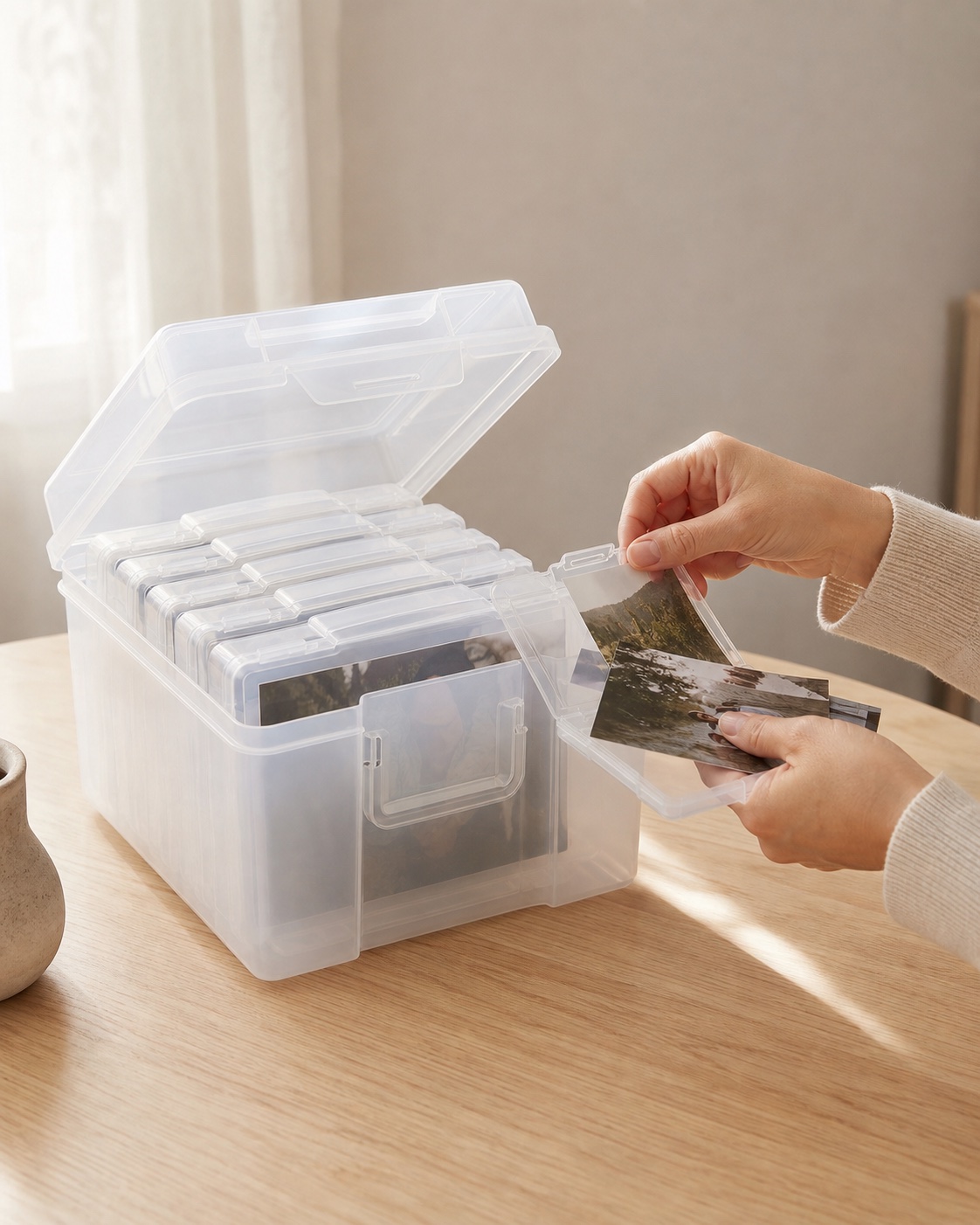
Current product facts: the COOVOAMAE Clear Photo & Card Storage Box uses a transparent outer organizer with individual inner cases. It is intended to keep printed photos, greeting cards, stickers, seed packets, craft supplies, keepsakes, and other small items visible and separated.
COOVOAMAE describes it as an organizational product, not a preservation-grade archival enclosure. For irreplaceable photographs, use suitable inner sleeves or envelopes and confirm that the combined dimensions fit before placing them in an inner case.
For material, handling, plastic, environment, and damage boundaries, read How to Store Printed Photos and Cards.
Frequently asked questions
Are photo boxes better than albums?
They are better for flexible sorting, compact storage, and growing collections. Albums are better for a curated sequence that people will browse. Preservation depends on the specific materials and storage conditions in either format.
Is a plastic photo box archival?
Not automatically. Look for documented materials and photographic-storage information. Treat a general craft organizer as an organization layer unless its preservation performance is specifically supported.
Should every photograph go into a sleeve?
The answer depends on the photographic process, condition, size, value, handling frequency, and enclosure system. Use preservation guidance or a qualified conservator for vulnerable or important collections.
What should I do with photographs already in an old album?
Document the page order, captions, and binding before changing anything. Do not force out photographs that are stuck or bonded to adhesive. Seek qualified advice when removal could cause damage.
Which format is easier for children or relatives to use?
An album is often easier for guided viewing. A clearly labeled box can be easier for finding a specific person, date, or event. Access copies can protect originals when frequent handling is expected.
Sources and methodology
This comparison separates organization and access from preservation claims. Handling, enclosure, album, and storage boundaries draw on primary guidance from the Library of Congress and U.S. National Archives. Product statements are limited to the current COOVOAMAE organizational format; no archival rating is claimed.
- Library of Congress: Care, Handling, and Storage of Photographs — FAQs
- Library of Congress: Care, Handling, and Storage of Photographs
- U.S. National Archives: How do I house photographs?
- U.S. National Archives: Storing Family Papers and Photographs
- COOVOAMAE: Clear Photo & Card Storage Box Collection
Preservation note: Irreplaceable, historic, damaged, mold-affected, or unusually valuable photographs may require advice from a qualified photographic conservator.