The short answer
Vacuum compression bags can save suitcase or closet space by removing air from compressible items such as sweaters, jackets, bedding, and other soft textiles. They reduce packed volume; they do not reduce the weight of what you carry. That distinction matters because a smaller-looking suitcase can still exceed an airline’s weight limit. Results vary with the fabric, how tightly items are folded, the bag size, seal quality, valve design, and how much air is removed, so a universal percentage claim is not useful. Compression is best for bulky, resilient textiles and less suitable for rigid objects, delicate structured garments, or items that need frequent access. After compressing, measure and weigh the finished bag, check the luggage rules for your airline and route, and leave enough room to repack. If the system includes an electric pump, also verify its battery and transport requirements before flying.
The practical question is not whether compression “works” in the abstract. It is whether reducing volume solves the packing problem you actually have without creating a weight, access, fabric-care, or repacking problem later.
When does compression solve the wrong problem?
Compression will not fix an overweight suitcase, a bag that exceeds a rigid external dimension, or an itinerary where you need to open the same clothing bundle repeatedly. It can also move empty space rather than eliminate a packing problem: a dense, awkward slab may be harder to arrange around shoes, wheels, or a suitcase handle than several smaller groups.
Before buying a system, identify the actual constraint. If weight is the problem, remove items or choose lighter ones. If organization is the problem, simple packing cubes may provide easier access without a pump. If bulk from soft textiles is the problem, compression may be the right tool. A good system can also combine methods: small uncompressed cubes for frequently used items and one compression bag for bulky layers. Our detailed comparison of vacuum bags versus packing cubes turns those tradeoffs into a trip-by-trip decision.
What do vacuum compression bags change?
Soft textiles contain air between folds, fibers, and layers. A compression bag lets you close those items inside a flexible enclosure and remove some of that air through a valve. The bundle becomes denser, which can make it easier to organize a suitcase, fit seasonal textiles into a closet, or separate categories of clothing.
The contents themselves do not become lighter. A compressed bag of clothing has almost the same mass as the uncompressed clothing plus the bag. This is why volume and weight should be treated as two separate packing limits.
For a closer look at the scale reading, bag weight, and why compression can still lead to an overweight suitcase, see whether vacuum bags make luggage heavier.
Which items compress well—and which do not?
| Usually a good fit | Use more caution | Why |
|---|---|---|
| Sweaters, fleece, casual clothing | Structured jackets and tailored garments | Structure, shoulder shape, and pressing may be affected |
| Soft bedding and towels | Fragile embellishments or delicate textiles | Pressure and folding may damage sensitive finishes |
| Seasonal soft goods | Items needed repeatedly in transit | Opening one bag releases compression and requires repacking |
| Clean, fully dry textiles | Damp, soiled, or odor-trapping items | Sealing moisture and residue is poor storage practice |
| Flexible items without sharp edges | Rigid or sharp objects | Edges can puncture the bag or prevent an even seal |
How much space can a compression bag save?
There is no single honest percentage for every trip. A lofty jacket usually gives up more air than a dense T-shirt. A careful fold may compress more evenly than a loosely stuffed bundle. The bag, valve, closure, and pump also affect the result.
A more useful test is to compare the actual bundle before and after:
- Choose the items you genuinely plan to pack.
- Fold them and record the uncompressed bundle’s approximate dimensions.
- Load the bag without covering the closure or exceeding its fill line.
- Seal it fully, remove air, and let the bag rest for several minutes.
- Measure the compressed bundle and weigh the complete suitcase.
- Recheck it later to see whether the seal is holding.
This small home test is more relevant than a best-case marketing demonstration because it uses your fabrics, packing style, and luggage.
Do compression bags help with airline baggage limits?
They can help with a space limit, but they can make it easier to add more items and unintentionally exceed a weight limit. Airlines set their own size and weight rules, and those rules can vary by carrier, route, fare, cabin, and bag type. Always use the current rule for your exact itinerary.
The U.S. Transportation Security Administration maintains a searchable list for what may go through security, while the Federal Aviation Administration publishes baggage guidance for batteries and powered devices. Those sources do not replace your airline’s own acceptance rules.
Before leaving home: weigh the final suitcase, measure it in its packed shape, and leave a workable plan for the return trip. A vacuum bag that was easy to close with a pump at home may need to be recompressed elsewhere.
What should you check about an electric pump?
First, identify the exact power source from the pump label or manual rather than assuming. If it contains a rechargeable lithium battery, airline and aviation-safety rules may affect whether and how it can be packed. Spare batteries generally receive different treatment from batteries installed in equipment.
Protect the pump from accidental activation and physical damage. Keep its terminals and charging port protected, and follow the airline’s instructions. Rules can change, so confirm them close to travel using the relevant airline and aviation authority.
How do you pack a reusable compression bag well?
- Start clean and dry. Do not seal damp textiles for storage or travel.
- Match the bag to the load. Leave the closure area flat and free of fabric.
- Fold instead of making a hard lump. An even layer tends to form a more manageable shape.
- Check the double seal. Run the closure tool or your fingers across the full width, then check it again.
- Use the correct valve connection. Keep the valve clean and follow the pump instructions.
- Stop at a useful shape. The goal is a packable bundle, not maximum hardness.
- Close the valve and inspect. Watch for folds, trapped fabric, or slow reinflation.
Why does a bag sometimes reinflate?
Common causes include an incompletely closed seal, debris or fibers across the seal, a valve cap that is not fully closed, material caught around the valve, a puncture, or stress from overfilling. Slow reinflation does not always mean the pump is the problem.
Empty the bag, inspect it in good light, clean the closure, reload with less material, and reseal on a flat surface. Avoid sharp objects and do not drag a compressed bag against rough luggage hardware. Replace a damaged bag rather than relying on tape during a trip.
How does the COOVOAMAE Travel Vacuum Compression System work?
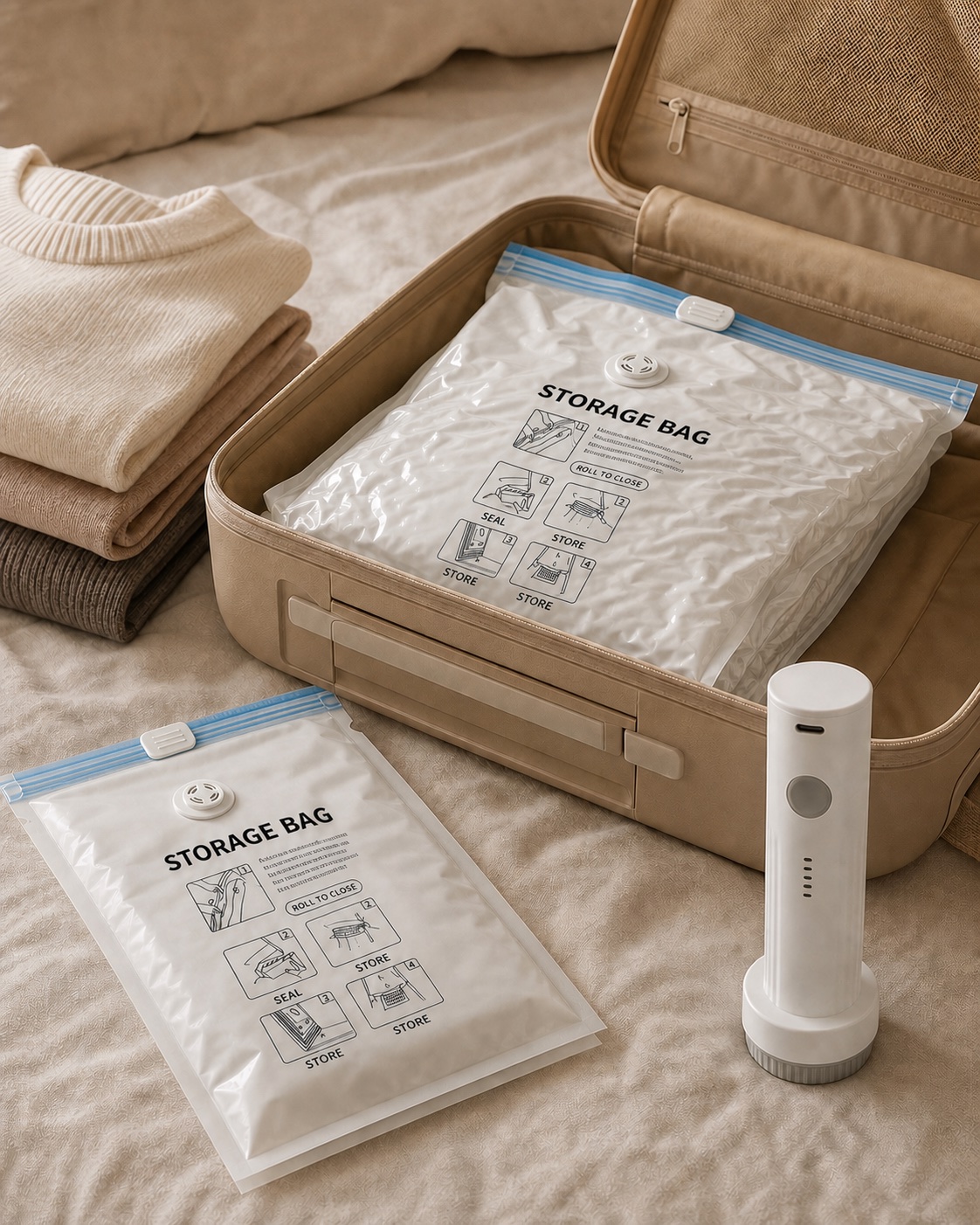
Current product facts: the COOVOAMAE system combines reusable PA+PE compression bags with a compact electric pump, double-seal closures, and air valves. It is intended for clothing and other soft textiles in suitcases, dorm rooms, closets, and seasonal storage.
The system reduces packed volume, not weight. Available bag sizes, included quantities, pump specifications, current price, and delivery details should be confirmed on the exact marketplace listing.
Can compression bags be used for long-term storage?
They can organize clean, dry, resilient textiles, but suitability depends on the item and storage environment. Long periods under compression may not be appropriate for structured garments, delicate fills, specialty fabrics, or objects whose manufacturer advises against compression. Check the care label and periodically inspect the contents and bag.
Compression bags are not a substitute for a cool, dry, clean storage location. They also do not correct an existing moisture, pest, or contamination problem.
Frequently asked questions
How many bags should I use?
Use enough to keep each load flat, closable, and useful in the suitcase. Several moderate bags are often easier to arrange and reopen than one overfilled bag. Match the bag sizes to your suitcase dimensions and the categories you want to access separately.
Do vacuum bags make luggage lighter?
No. They remove air and reduce volume, but the clothing still weighs the same. Weigh the completed luggage after packing.
Should I roll or fold clothes first?
Either method may work, but a flat, even load usually creates a more useful final shape than a dense ball. Test the method with your fabrics and bag dimensions.
Can every garment be compressed?
No. Use caution with tailored, structured, delicate, embellished, or manufacturer-restricted garments. Do not pack rigid or sharp items in a flexible compression bag.
Can the pump go in checked baggage?
That depends on the exact device and battery. Identify the battery specification, consult the current airline rules, and use official aviation guidance before packing it.
Sources and methodology
This guide distinguishes physical volume reduction from airline weight rules and avoids a universal compression percentage. Travel guidance links to U.S. federal primary sources; your airline and destination may impose additional requirements.
- U.S. Transportation Security Administration: What Can I Bring?
- Federal Aviation Administration: Lithium batteries in baggage
- Federal Aviation Administration: PackSafe and baggage guidance
- Federal Aviation Administration: Battery-powered and heat-producing devices
- COOVOAMAE: Travel Vacuum Compression System product information
Travel note: Security, airline, and battery rules vary and can change. Confirm the requirements for the exact device, carrier, route, and destination before travel.