The short answer
To store printed photos and cards at home, first sort them by size and importance, then place them in clean enclosures that fit without bending or crowding. Keep irreplaceable photographs in materials specifically identified as suitable for photographic storage; “clear,” “plastic,” or “acid-free” alone does not prove archival suitability. Use an outer box to organize protected groups, label the enclosure rather than the original image, and store everything in a cool, dry, stable place away from direct light, leaks, pests, and rapid temperature or humidity changes. Handle prints by their edges with clean, dry hands; clean gloves may be appropriate for vulnerable materials. Avoid pressure-sensitive tape, rubber bands, sticky album pages, and unverified plastics. A clear multi-case organizer is useful for visibility, sorting, and everyday access, but it should be treated as an organizational layer unless its material and photographic-storage testing are explicitly documented.
Good storage begins by separating two jobs that are often confused: preserving the image and organizing the collection. One enclosure may do both, but a convenient household organizer is not automatically a preservation-grade photographic enclosure.
If you are deciding between two common formats, compare a photo storage box and a photo album by viewing access, sorting flexibility, expansion, and preservation needs.
Which photographs need the most cautious treatment?
Give priority to originals that are irreplaceable, historically important, physically fragile, unusually old, or made by an unfamiliar photographic process. Negatives, slides, instant photographs, mounted prints, albums, and color materials can have different needs. Do not separate a photograph from a mount or album merely to make it fit a new container.
Everyday reprints, modern greeting cards, craft supplies, and duplicates may be organized for frequent access with a simpler system. When a box contains both replaceable and irreplaceable objects, separate them into clearly labeled inner groups so routine handling does not repeatedly expose the originals.
What is the safest way to start?
- Work on a clean, dry surface. Keep food, drinks, pens, and household cleaners away.
- Sort by size and use. Separate frequently handled prints, cards, duplicates, and irreplaceable originals.
- Measure the actual items. Include mounts, sleeves, borders, or unusually thick cards.
- Choose the inner enclosure first. Sensitive originals may need individual sleeves or envelopes made for photographic materials.
- Choose the outer organizer. It should fit the protected items without bending and be easy to lift and label.
- Pick a stable location. Avoid attics, basements with moisture risk, direct sunlight, exterior walls with condensation, and places near pipes.
What is the difference between everyday organization and archival care?
| Question | Everyday organization | Preservation-focused storage |
|---|---|---|
| Main goal | Visibility, sorting, portability, frequent access | Long-term protection of valuable or irreplaceable material |
| Inner enclosure | May use a fitted household case | Uses documented photographic-storage sleeves, envelopes, or folders |
| Material evidence | General product material description | Specific suitability information; the Image Permanence Institute’s Photographic Activity Test may be relevant |
| Handling | Clean, dry hands and edge handling | Minimal handling, edge support, and clean gloves when appropriate |
| Environment | Clean household cabinet away from sunlight and moisture | Cool, dry, stable conditions with closer environmental control |
| Labeling | Labels on cases or dividers | Documentation kept with the enclosure; avoid marking the image surface |
The Library of Congress and U.S. National Archives emphasize preventive care: suitable enclosures, careful handling, protection from light, and a cool, dry, stable environment. Their guidance is especially important for family originals, historic prints, negatives, or materials that cannot be replaced.
Which storage materials should you look for?
For valuable photographs, use products whose manufacturers clearly identify the material and its suitability for photographic storage. The Library of Congress notes that enclosure materials should pass the Photographic Activity Test. It also identifies stable plastics such as uncoated polyester film, polyethylene, and polypropylene for certain photographic uses.
Do not infer preservation performance from appearance. A clear case can be excellent for finding and grouping items but still lack the documentation needed for direct, long-term contact with an irreplaceable print. In that situation, place the photograph in a suitable inner sleeve or envelope before putting it into the organizer.
A useful rule: if the storage product does not state the exact material or relevant photographic-storage testing, use it as the outer organizational layer rather than making an archival claim.
What should you avoid?
- Pressure-sensitive tape, self-stick album pages, and adhesives applied to original photographs
- Rubber bands, paper clips, and fasteners that create pressure, rust, or surface marks
- Polyvinyl chloride (PVC) and other unverified plastics in direct contact with photographs
- Glassine for long-term photographic enclosure use
- Overfilled boxes that bend corners or make removal difficult
- Direct sunlight and prolonged display without considering light damage
- Damp, hot, or rapidly changing locations such as many attics, garages, and basements
- Writing on the image surface with pens or markers
If an item is stuck to an album page, curled, brittle, mold-affected, torn, or otherwise vulnerable, do not force it flat or pull it free. Isolate active mold from other materials and consult a qualified conservator for significant objects.
How should photographs be handled?
Handle photographs as little as practical and support them fully. The National Archives recommends clean gloves for photographs and negatives, while the Library of Congress advises clean, dry hands and handling by the edges; its detailed guidance also discusses gloves for photographs in some situations. The safest choice depends on the object and your ability to maintain control without creasing or dropping it.
Keep the work area uncluttered. Move one group at a time, and avoid stacking loose prints where surfaces can rub. If you need to identify the contents, label the sleeve, case, divider, or a separate slip rather than the front of the photograph.
How do you choose the right box size?
Measure width, height, and thickness. Then allow for any inner sleeve, envelope, or mounted edge. A box that technically fits the bare print may be too tight once a protective enclosure is added.
Choose a format that supports the items without forcing them to bow. Small groups are often easier to retrieve from individual cases than from one deep undivided box. If the collection includes multiple formats, do not assume a single case size will suit every photograph, postcard, greeting card, sticker sheet, or craft item.
How does the COOVOAMAE Clear Photo & Card Storage Box fit this system?
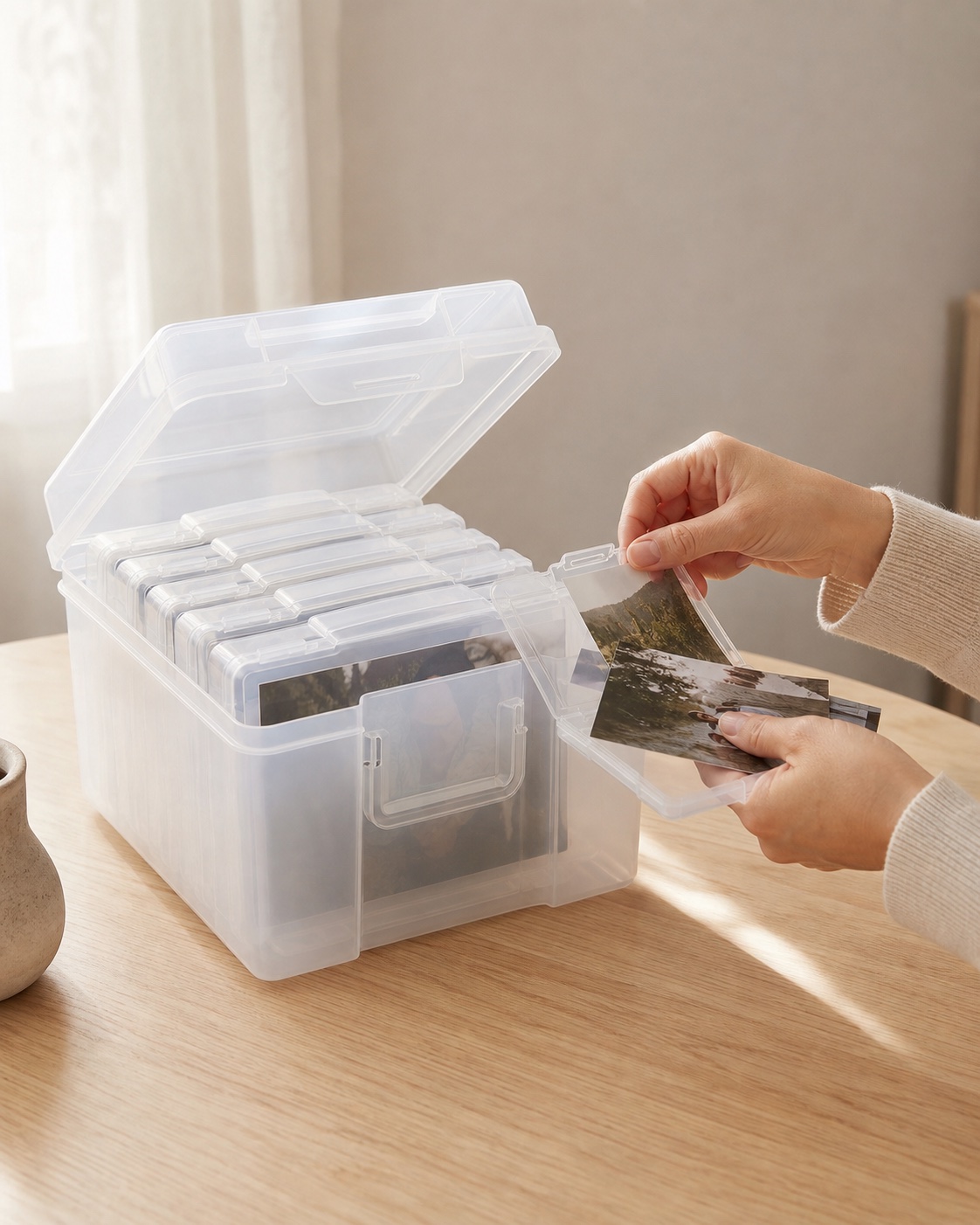
Current product facts: the COOVOAMAE collection uses a transparent outer organizer with individual inner cases. Multiple size and case-count options are linked from the product page. The format is designed to keep photos, greeting cards, stickers, seed packets, craft supplies, and small keepsakes visible and separated.
COOVOAMAE describes this as an organizational product, not a preservation-grade archival enclosure. For irreplaceable or sensitive photographs, use an appropriate photographic sleeve or envelope inside the organizer and confirm that the combined dimensions fit.
Where should a photo collection be stored at home?
Choose an interior location that stays relatively cool, dry, clean, and stable. A main living area is often more stable than an attic, garage, or basement. Keep the box above floor level and away from water pipes, radiators, exterior heat, and direct sun.
Light matters even when photographs are inside a box because items are often left out during sorting or display. Return prints to their enclosures after use. Inspect the storage area periodically for water, insects, odor, dust, and changes to the enclosure or photographs.
How do you create a simple labeling system?
If the main obstacle is the size of the unsorted collection rather than the choice of enclosure, start with our simple system for organizing printed photos. It separates the sorting, identification, labeling, and indexing workflow from the preservation decisions covered here.
- Give each inner case a short neutral label such as year, person, trip, event, or format.
- Add an index card or digital inventory for names and context that may change.
- Record uncertainty honestly—use “possibly” or a question mark instead of turning a guess into a fact.
- Keep duplicates and working copies separate from irreplaceable originals.
- Photograph or scan labels and important originals as an access copy, while remembering that a digital copy also needs backup and file management.
Frequently asked questions
How often should I inspect stored photographs?
Check them periodically and after any leak, move, pest event, or major environmental change. Look for moisture, odor, sticking, color change, brittleness, insects, damaged enclosures, and labels that no longer make sense. Early detection is more useful than waiting for a fixed calendar date.
Is any clear plastic box safe for old photographs?
No. Clarity does not establish chemical stability or photographic suitability. For valuable originals, look for exact material information and relevant testing, or use a documented photographic enclosure inside the organizer.
Can photos be stored in the garage or attic?
Those spaces often experience heat, humidity, and rapid environmental changes. A stable interior location is usually the safer household choice.
Should I wear gloves?
Clean gloves may be appropriate for photographs and negatives, especially vulnerable materials, but good support and careful edge handling are also important. Follow the guidance appropriate to the specific object.
Can I put labels directly on photographs?
Prefer labeling the enclosure or keeping a separate index. Avoid pens, adhesive labels, and pressure-sensitive tape on the image surface.
Sources and methodology
This guide uses preservation guidance from the Library of Congress and U.S. National Archives. Product-specific statements are limited to the current COOVOAMAE organization format; no archival rating is claimed.
- Library of Congress: Care, Handling, and Storage of Photographs — FAQs
- Library of Congress: Care, Handling, and Storage of Photographs
- U.S. National Archives: How do I house photographs?
- U.S. National Archives: Storing Family Papers and Photographs
- COOVOAMAE: Clear Photo & Card Storage Box Collection
Preservation note: Irreplaceable, historic, damaged, mold-affected, or unusually valuable materials may require a qualified photographic conservator and storage selected for the specific process and condition.