The short answer
Vacuum bags do not make the clothing inside heavier, and they do not meaningfully reduce its weight. They remove air and reduce volume, so the packed bundle becomes smaller and denser. The only added weight is the bag itself and, if you carry one, the pump. The practical risk is indirect: once bulky clothing takes up less room, it becomes easier to add more items and push a suitcase over the airline’s weight limit. Treat compression and weight as separate checks. Use a vacuum bag when soft textiles are consuming too much space, but weigh the complete suitcase after every packing change. A smaller-looking bag can still be overweight. For air travel, confirm the allowance for your exact airline, route, fare, and bag type; if the system uses a battery-powered pump, also check the current rules for that device before deciding where to pack it.
The confusion comes from a visual shortcut: a smaller bundle looks as if there is less of it. Compression changes shape and volume, not the amount of clothing you are carrying.
Do vacuum bags reduce luggage weight?
No. Removing air from between layers of fabric reduces the space those layers occupy, but it does not remove the fabric. A sweater has essentially the same mass before and after compression. Once you include the reusable bag, valve, closure, and optional pump, the packed system weighs slightly more than the clothing alone.
This does not make vacuum bags a poor travel tool. It means they solve a volume problem rather than a weight problem. If a coat or several sweaters prevent a suitcase from closing, compression may create a more manageable shape. If the suitcase is already near its weight allowance, compression cannot correct that constraint.
Why can a compressed suitcase end up heavier?
The suitcase becomes heavier only when compression changes your packing behavior. Empty space invites additional items: another pair of shoes, more outfits, souvenirs, or toiletries. The smaller bundle also makes the total load look less substantial, so weight can be underestimated.
The useful rule: compression creates capacity, not weight allowance. If you use the new space, assume the suitcase may be heavier until a scale confirms otherwise.
This is why the final weight—not the appearance of the suitcase—should decide whether the packing plan works. Weigh the complete bag with the compression bags, pump, shoes, toiletries, and every last-minute item inside.
What changes when you compress clothing?
| Factor | Before compression | After compression |
|---|---|---|
| Clothing weight | Unchanged baseline | Essentially unchanged |
| Packed volume | More air between folds and layers | Less air and a denser bundle |
| System weight | Clothing only | Clothing plus bag and optional pump |
| Available suitcase space | Less | Potentially more |
| Overweight risk | Depends on the original load | Can rise if the new space is filled |
| Access | Items can be easier to separate | Opening the bag releases compression |
The exact volume change depends on the contents, bag size, fold, seal, valve, and amount of air removed. Lofty textiles usually change shape more than dense fabrics. A universal compression percentage is therefore less useful than a test with the items and suitcase you actually plan to use.
How can you test the real weight at home?
- Weigh the empty suitcase. This gives you a stable baseline.
- Add the intended clothing without compression. Record the total.
- Place the same clothing in the vacuum bag. Do not add or remove garments.
- Compress and repack it. Include the pump if it will travel with you.
- Weigh the suitcase again. The difference should mainly reflect the bag and pump.
- Add any items enabled by the new space. Weigh the suitcase a final time.
The third measurement is the one travelers often skip. It shows whether the convenience of extra capacity has turned into an overweight-bag problem.
When should weight determine the packing method?
Choose by the constraint you need to solve:
- If the suitcase is too bulky but comfortably under its weight limit: compression may help.
- If the suitcase is already too heavy: remove items, substitute lighter items, or redistribute the load according to the carrier’s rules.
- If frequent access matters: packing cubes may be easier because they can be opened without a pump or full recompression.
- If both bulk and access matter: use a small number of compression bags for bulky layers and ordinary cubes for daily clothing.
Our guide to vacuum bags versus packing cubes compares these options by space, access, wrinkles, repacking, and trip type.
Can vacuum bags help with carry-on size limits?
They may help a soft load fit inside a suitcase or backpack, but they cannot change the fixed external dimensions of the luggage. A rigid case remains the same size. A soft-sided bag may become easier to close, yet overfilling can still create bulges that affect its measured shape.
Airlines set their own baggage rules, and the allowance may vary by carrier, route, cabin, fare, and bag type. Measure the final packed bag and check the current rule for the exact itinerary. Do not use a general rule from a different airline as a substitute.
Which items are worth compressing?
Compression is most useful for clean, dry, flexible textiles that contain a meaningful amount of trapped air. Sweaters, fleece, casual clothing, towels, and some bedding are common examples. Dense T-shirts may compress less dramatically, while rigid objects do not benefit.
Use caution with tailored garments, structured jackets, delicate finishes, embellishments, specialty fills, and anything whose care instructions discourage compression. Keep sharp or rigid objects out of flexible vacuum bags, and avoid sealing damp or soiled textiles.
Does maximum compression always make better luggage?
No. A very hard, uneven slab can be awkward to arrange around wheels, shoes, or a telescoping handle. Extreme compression may also make the bag difficult to close or place more stress on the seal. The goal is a stable, packable bundle—not the smallest possible shape at any cost.
Several moderate bags can be easier to position and reopen than one overloaded bag. Grouping items by use also helps: one bag for outer layers, one for sleepwear, and an uncompressed cube for clothing needed immediately after arrival.
What should you know about traveling with a pump?
Identify the pump’s power source from its label or manual. If it contains a rechargeable lithium battery, follow the current airline and aviation guidance for battery-powered devices. Protect it from accidental activation and physical damage, and keep terminals and charging ports protected.
Rules for installed batteries, spare batteries, carry-on baggage, and checked baggage can differ. Confirm the exact device with the airline rather than relying on the fact that the pump is small.
How does the COOVOAMAE system fit this decision?
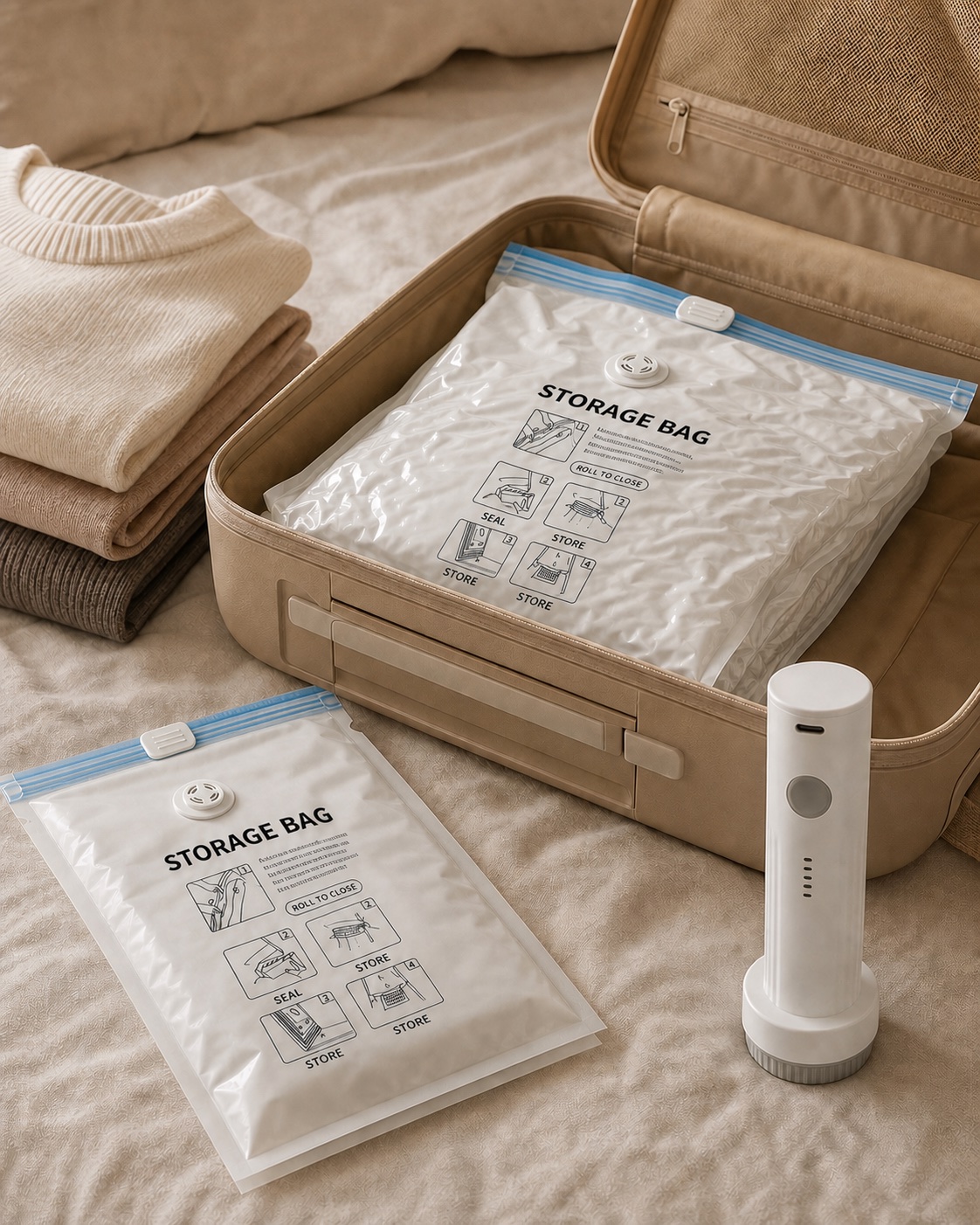
Current product facts: the COOVOAMAE Travel Vacuum Compression System combines reusable PA+PE compression bags with double-seal closures, air valves, and a compact electric pump. It is intended for clothing and other soft textiles used in suitcases, dorm rooms, closets, and seasonal storage.
The system reduces packed volume, not weight. Confirm the current bag sizes, included quantities, pump specifications, price, and delivery details on the exact marketplace listing.
For a broader explanation of which fabrics compress well, reinflation causes, sealing steps, and storage boundaries, read Do Vacuum Compression Bags Save Space?
Frequently asked questions
Do vacuum-sealed clothes weigh less?
No. The clothes retain essentially the same weight. The bag and optional pump add a small amount to the total load.
Does removing air remove measurable weight?
For ordinary travel packing, any change from removing the air inside the bag is not a useful way to reduce baggage weight. Use a luggage scale and treat the packed system as clothing plus the bag and pump.
Can vacuum bags cause an airline overweight fee?
They can contribute indirectly if the extra space encourages you to pack more. The fee depends on the carrier’s current rules and the final measured weight, not whether the clothing is compressed.
Should I weigh luggage before or after compression?
Weigh it after compression and after all final items are added. If you will carry the pump in the same suitcase, include it in the measurement.
Are packing cubes lighter than vacuum bags?
That depends on the specific cube, bag, and pump. Compare the actual product weights and choose based on your trip’s main constraint: weight, volume, access, or organization.
Sources and methodology
This guide separates physical volume from baggage weight and avoids universal airline allowances or compression percentages. Product statements are limited to the current COOVOAMAE system description. Confirm airline and battery rules close to departure because requirements can change.
- Federal Aviation Administration: PackSafe and baggage guidance
- Federal Aviation Administration: Lithium batteries in baggage
- U.S. Transportation Security Administration: What Can I Bring?
- COOVOAMAE: Travel Vacuum Compression System product information
Travel note: Airline, security, and battery requirements vary by carrier, route, destination, fare, device, and bag type. Verify the current requirements for your itinerary before travel.